
Good outdoor lighting does more than make a house look bright after sunset. It helps people read a step, follow a walk, find an entrance, and use a patio without turning the whole yard into one evenly lit field.
Walk the property after dark
For Northwest Georgia homeowners, useful placement starts with the property as it is. Complete Lawn Service installs permanent low-voltage outdoor lighting for paths, steps, entrances, landscapes, trees, walls, and gathering areas. The plan should give each fixture a clear job and leave the rest of the night intact.
Start at the places where people arrive and move: the driveway, front walk, porch, side gate, patio door, backyard steps, and route between outdoor areas. Walk those routes after sunset instead of trying to judge them only during an afternoon visit.
Look for changes in elevation, edges that disappear, turns in the path, and spots where a person moves from a bright area into a darker one. Notice existing porch lights, garage lights, and light coming through windows. A new fixture may not be needed where another source already provides useful visibility.
Views matter too. Check proposed locations from the front door, main windows, and patio chairs. A fixture that seems subtle from one direction may expose a bare lamp or sharp beam from another.
If outdoor lighting is part of a wider project, the guide to landscape design before installation offers a useful way to document light, water, movement, and existing features before work begins.
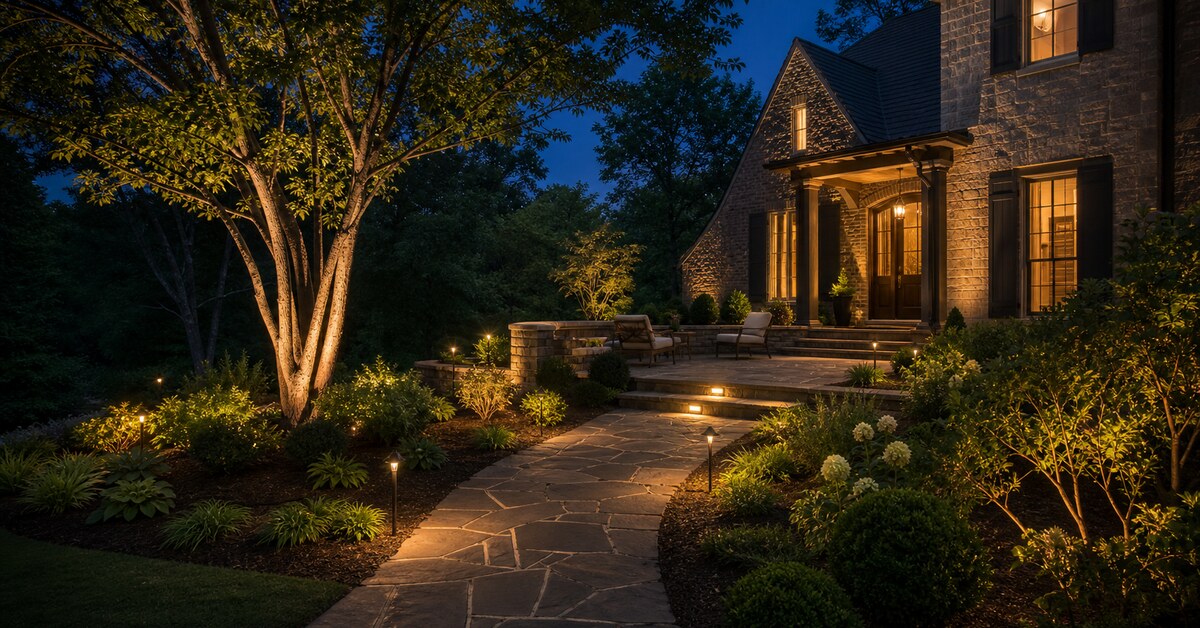
Light paths and steps as a connected route
Path lighting works best when it helps the eye follow a route rather than creating a row of bright dots. Mark where the path begins, changes direction, meets another surface, or passes through a darker area. Straight sections may need fewer visual cues than a curve, a narrow passage, or a transition from driveway to walk.
For steps, review the top and bottom of the run, tread edges, nearby walls or rails, and the direction people approach. A fixture aimed toward the person climbing can create glare. Direct light toward the walking surface without putting the source in the normal line of sight.
Keep fixtures out of the walking surface and away from door swings and foot landings. Lighting improves nighttime visibility, but it does not correct a loose paver, uneven step, missing rail, or other physical concern.
Give patios and entries enough light, not the same light
An entry needs clear visibility at the door, lock, threshold, and approach. A patio has a different job. It may need light near steps and edges, along with softer illumination that supports conversation or dining without shining into anyone's face.
Review the patio from seated height, where a bright source may feel more intrusive. Aim fixtures away from chairs and nearby windows, and let walls, planting, and the hardscape define where light should stop.
For a new patio, walkway, seating wall, or retaining wall, discuss lighting before construction. Some fixtures can be set into steps or walls, and concealed wiring is easier to coordinate before finishes close the route. Complete Lawn Service's residential hardscaping page explains why grade, drainage, movement, and nearby features belong in the same early conversation. The related patio planning guide covers that coordination in more detail.
Use trees and planting as focal points
A mature tree can look completely different after dark, but the fixture should be placed for a specific view. Decide whether the trunk, branching structure, or canopy is the feature worth seeing. Then check the beam from the house, patio, walk, and street-facing view before making the location permanent.
One carefully aimed accent can do more than several fixtures competing for attention. Leave quieter areas between focal points instead of lighting every tree or shrub at the same intensity.
Plant growth changes the result. A shrub may eventually cover a fixture, while a perennial may hide it seasonally. Keep service access in mind and coordinate new beds or screening with landscape design and installation so mature size informs the lighting layout.
Control glare at the source
More light does not automatically create better visibility. A bright source in a dark setting can draw attention to the fixture instead of the step, path, tree, or wall it is meant to reveal.
Glare control begins with placement, shielding, and aim. The lamp should be difficult to see from normal walking, seating, and indoor viewing positions. Keep the beam on its intended surface and out of neighboring windows, the road, and the open sky. Reflective pale stone, light siding, glass, and water can send more light back than expected, so review the effect on the actual materials.
Use the lowest useful level and decide when the system should operate. Timers and other controls can limit operation to the hours the property is in use. Review the result after dark because beam edges, reflections, and glare are hard to judge in daylight.
Plan wiring before the landscape closes around it
Fixture placement and wiring are one plan. The route needs to connect the fixtures and equipment without becoming an avoidable conflict with hardscape construction, drainage work, irrigation components, or future planting.
Map walls, beds, walks, drives, and known utility areas. For a new patio, wall, or walkway, identify sleeves, fixture openings, and concealed routes before installation. Keep cable away from future planting holes. Utility locating and current installation requirements belong in the plan before excavation.
Irrigation deserves a separate check. A cable route or fixture should not block access to heads, valves, or other service points. New beds and hardscape can also change what an existing system needs to water. Reviewing residential irrigation alongside the lighting layout helps identify those conflicts while locations are still flexible.
Place equipment where controls remain accessible for inspection and service. Leave a simple record of fixture and wire locations rather than relying on memory after routes disappear beneath mulch or turf.
Review the finished lighting from every important view
A plan on paper cannot show the whole nighttime result. After installation, walk the routes again. Sit in the patio chairs, look through the main windows, and approach the property from the driveway. Check that steps and turns are readable, accent lights land on their intended features, and no bare source dominates the view.
Seasonal growth can alter aim and coverage as shrubs widen or new planting enters a beam path. A fixture may need to be cleaned, aimed, or repositioned rather than replaced.
Complete Lawn Service serves homeowners in Cartersville, Calhoun, Rome, Adairsville, Kingston, and Emerson. The Northwest Georgia service area is residential, and outdoor lighting can be coordinated with the company's landscape, hardscape, and irrigation work when those needs overlap.
Frequently asked questions
Where should outdoor lighting be placed first?
Start with entrances, steps, walks, gates, the driveway-to-door approach, and transitions to gathering areas. Then choose a limited number of trees, walls, beds, or architectural details for accent lighting. Account for porch and garage lights so new fixtures do not duplicate useful light.
How can outdoor lighting avoid glare?
Place and shield fixtures so the bare source is not visible from walking routes, chairs, windows, or the road. Aim each beam only at its intended surface and begin with the lowest useful level. Review the system after dark for unexpected reflections.
Which lighting details should be settled before a patio or wall is built?
Decide whether fixtures will be integrated into steps, seating walls, retaining walls, or patio edges; then coordinate openings, sleeves, wire routes, transformer access, and service points before finished surfaces close those paths. Fixture models can sometimes change later, but the concealed infrastructure is easier to preserve during hardscape planning.
What changes when lighting is added around mature plants and existing hardscape?
Adding lighting to an established property requires routes that protect mature roots, avoid irrigation conflicts, and work around finished paving or walls. Fixture placement should account for plant growth, existing viewing angles, and future service access; the best route may differ from what would have been possible before installation.
Plan the nighttime walk before choosing fixtures
A useful outdoor lighting plan begins with movement and visibility, then adds a few focal points with controlled aim. Planning paths, steps, patios, trees, glare, wiring, irrigation, and future growth together produces a more coherent result than selecting fixtures one area at a time.
To discuss permanent outdoor lighting for a Northwest Georgia home, request an estimate and include the property address plus the entrances, walks, steps, trees, beds, walls, or gathering areas you want reviewed after dark. You can also call or text (770) 629-0903.